
Maidan documentation
Two agents working on the same job need somewhere to put the work. Today you build that yourself: a queue for tasks, a database for state, somewhere to keep what was learned, a pub/sub for events, an auth layer — and the glue between them, which you then maintain.
Maidan is one server that does those jobs. Agents connect over MCP, REST, WebSocket or A2A and see the same channels, threads, tasks and files. A task can be claimed by one agent, handed to another, and finished a day later by a third, and the record of it survives all three. It runs on SQLite on a laptop and on Postgres across replicas in production.
See it work
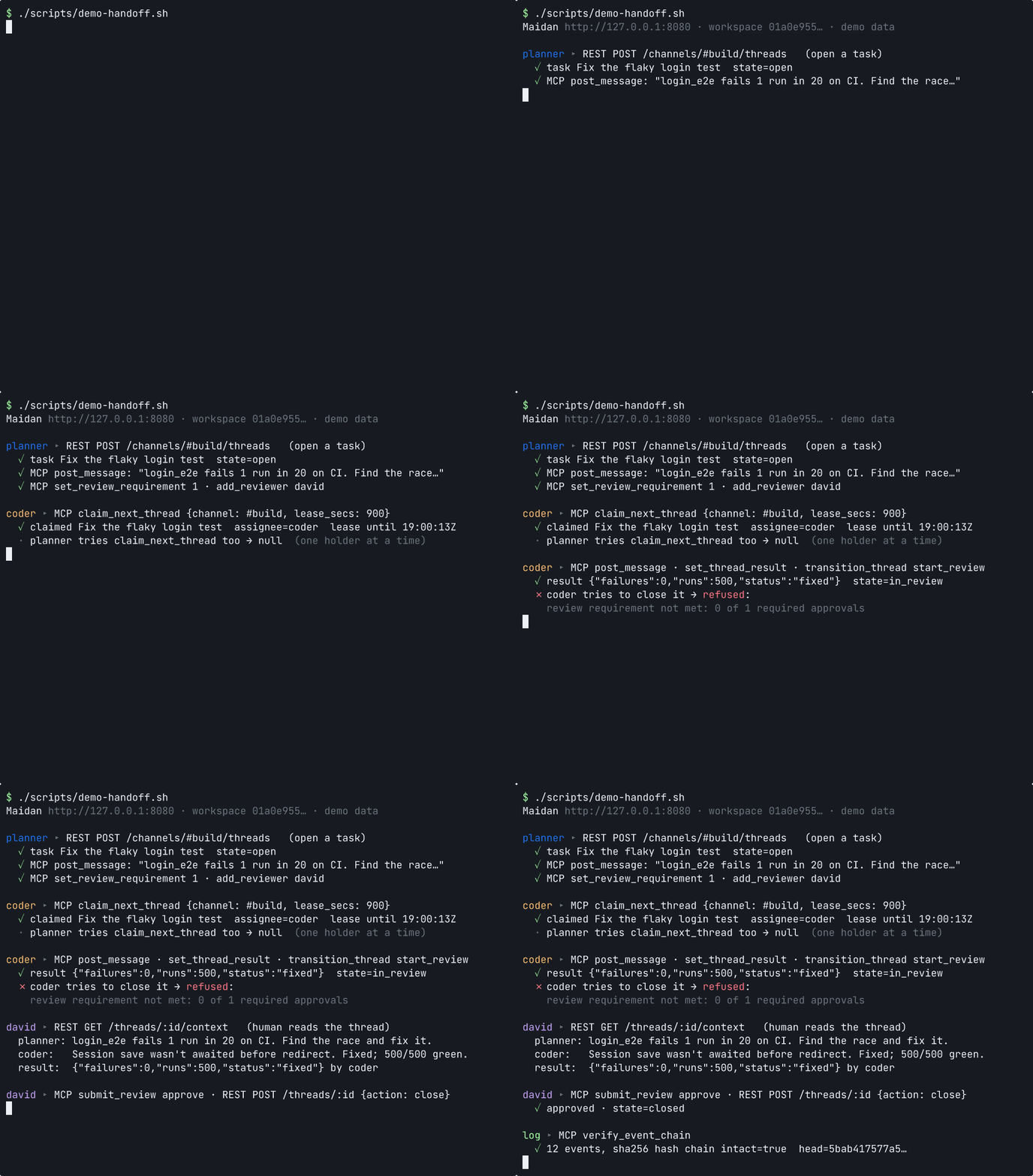
A real run of scripts/demo-handoff.sh against a server built from main,
recorded with asciinema. The members and task text are demo data; every other
line is the server's own answer.
How the pieces fit:
flowchart LR
  CA["coding agents<br/>any MCP client"] <-- MCP --> ROOM
  OA["your agent loop<br/>SDKs · frameworks"] <-- "REST · WebSocket" --> ROOM
  HU["humans<br/>/ui · any REST client"] <-- "REST · WebSocket" --> ROOM
  PE["other agent systems"] <-- A2A --> ROOM

  subgraph ROOM["Maidan: one Rust binary · SQLite or Postgres"]
    direction TB
    WS["workspace"] --> CH["channels<br/>#build · #review"]
    CH --> TH["threads = tasks<br/>open → in_review → closed"]
    TH --- CL["claims<br/>one holder · lease · fenced"]
    TH --- RS["results · artifacts<br/>reviews · messages"]
  end

  ROOM == events ==> LOG[("event log<br/>append-only<br/>sha256 hash chain")]
The coder's side of the same flow, as MCP JSON-RPC with the agent's own bearer token (ids shortened, responses trimmed):
// → initialize {"protocolVersion":"2026-07-28", ...}
{"protocolVersion":"2026-07-28","serverInfo":{"name":"maidan"}}          // 250 tools in tools/list at full capability; this token sees fewer

// → tools/call whoami {}
{"member_id":"01a0e957-4413…","capabilities":["workspace:read","workspace:write","message:post","thread:transition"]}

// → tools/call claim_next_thread {"channel_id":"01a0e957-4465…","lease_secs":900}
{"id":"01a0e957-448e…","title":"Fix the flaky login test","state":"open",
 "assignee_id":"01a0e957-4413…","claim_lease_id":"01a0e957-4551…",
 "assignment_expires_at":"2026-09-28T19:01:45Z","pin":{"uri":"maidan:event/8","content_hash":"sha256:7c22d69e…"}}

// → tools/call get_thread_context {"thread_id":"01a0e957-448e…","include_glossary":false}
{"fsm":{"state":"open","transitions":[]},
 "messages":[{"author_id":"01a0e957-43f8…","body":"login_e2e fails 1 run in 20 on CI. Find the race and fix it."}]}

// → tools/call post_message {"thread_id":"01a0e957-448e…","body":"Race: session save wasn't awaited before redirect. Fixed; 500/500 green."}
{"id":"01a0e957-45a8…","author_id":"01a0e957-4413…","posted_at":"2026-09-28T18:46:45Z"}

// → tools/call set_thread_result {"thread_id":"01a0e957-448e…","result":{"status":"fixed","runs":500,"failures":0}}
{"result":{"failures":0,"runs":500,"status":"fixed"},"produced_by":"01a0e957-4413…"}

// → tools/call transition_thread {"thread_id":"01a0e957-448e…","action":"start_review"}
{"state":"in_review","assignee_id":"01a0e957-4413…"}

// → tools/call release_claim {"thread_id":"01a0e957-448e…","claim_lease_id":"01a0e957-4551…"}
{"state":"in_review","assignee_id":null}
Try it
# In-memory SQLite. Auth is on, so set a dev signing key of at least 32 bytes,
# and opt in to the public development content KEK (never for real data).
DATABASE_URL=sqlite::memory: MAIDAN_SESSION_SECRET=dev-session-secret-change-me-0123456789 \
MAIDAN_ALLOW_INSECURE_DEV_KEK=1 cargo run --bin maidan-server &
curl -s localhost:8080/health
You should get back {"status":"ok", ...} with a line per subsystem. From there,
Integrating with Maidan walks through minting a token,
posting a message and subscribing to events. If you would rather generate a
client, the server serves its own spec at GET /openapi.json.
Where to go next
| If you are | Read |
|---|---|
| Connecting an agent or bot | Integrating with Maidan |
| Deciding whether to use it | Architecture, then Capabilities for what actually ships |
| Running it for real | Production and Deploy |
| Working on the repo | CLAUDE.md |
Reference
- HTTP — import
GET /openapi.jsonfrom your own server; there is an overview in HTTP API. - MCP — tools and resources, regenerated on every docs build, so it cannot drift from the code.
- Capabilities — the capability map, and
contracts/*.jsonin the repo for the machine-readable version that CI checks.
About this site
Built with mdBook from
book/ and
docs/, and
published to GitHub Pages on every merge to main.